
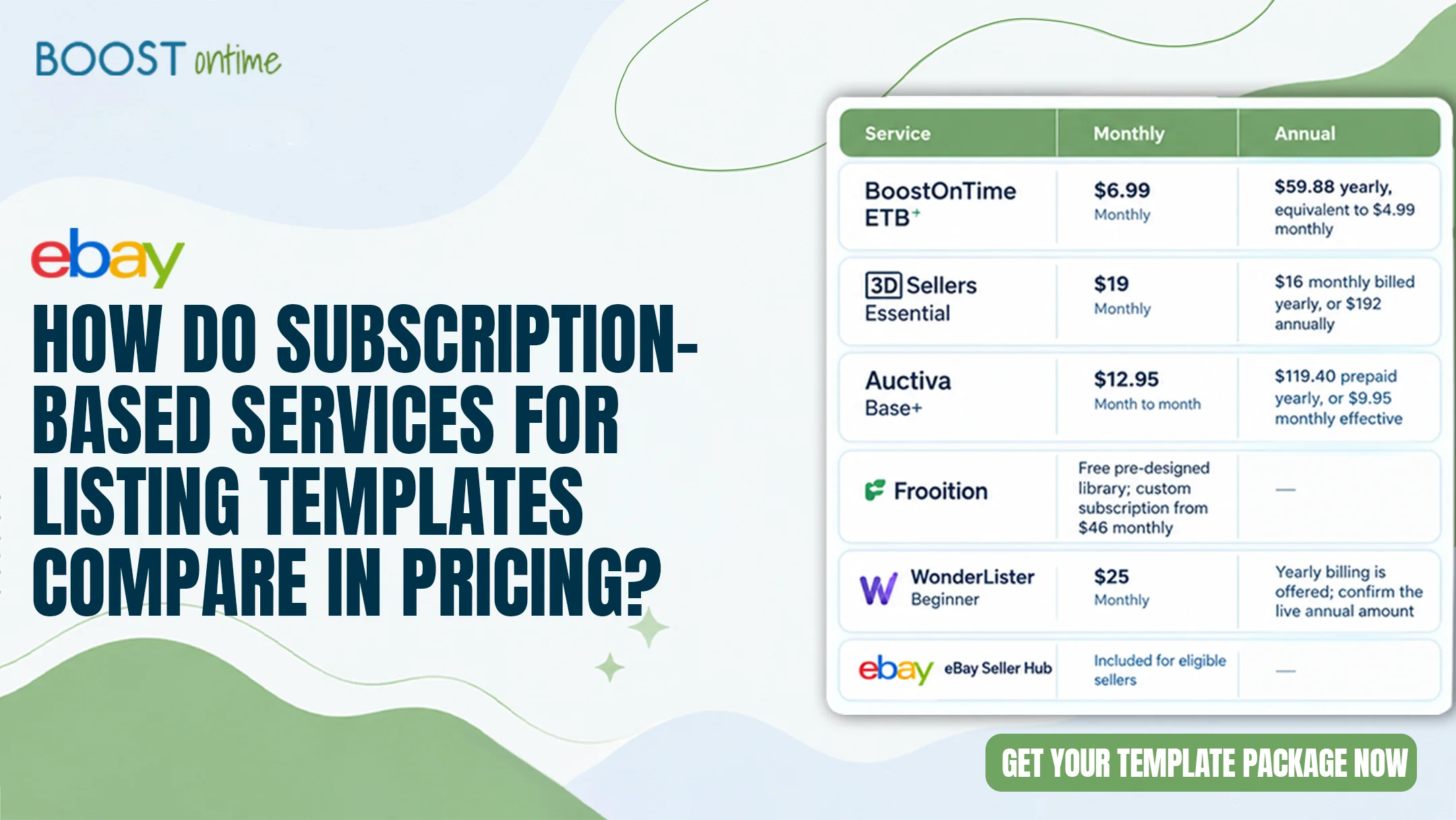
How Do Subscription-Based Services for eBay Listing Templates Compare in Pricing?
Comparing eBay template subscriptions takes more than checking the lowest monthly price. This guide examines annual cost, listing limits, overages, design services and included tools—and explains why BoostOnTime ETB is our best-value choice for sellers who primarily need professional, reusable eBay templates.
📋 In This Guide
- 1Quick Answer: Best Pricing?
- 2Why Headline Prices Don’t Tell the Whole Story
- 3Five Pricing Variables to Compare
- 4Provider-by-Provider Pricing Comparison
- 5Annual Cost Comparison
- 6Why BoostOnTime ETB Delivers Focused Value
- 7The True Annual Cost Formula
- 8Monthly or Annual Billing?
- 9Testing ETB During the 7-Day Trial
- 10Hidden-Cost Checklist
- 11Best Service by Seller Type
- 12Frequently Asked Questions
A template service priced at $4.99 per month may look cheaper than one priced at $19. Another service may advertise free templates, while a custom package begins at $46 per month. That appears to be an easy comparison—until one price is billed yearly, another covers only 100 listings, another adds a gross merchandise value fee, and the free option is not the same product as the managed design package.
That is why sellers asking how subscription-based services for eBay listing templates compare in pricing need to look beyond the headline number. The right question is not simply, “Which plan costs the least?” It is, “Which plan gives my business the template capabilities it actually needs at the lowest predictable total cost?”
For sellers whose main goal is to create professional, responsive eBay descriptions and maintain them efficiently, BoostOnTime eBay Template Builder, or ETB, is our best-value recommendation. Our monthly plan is $6.99. Our annual plan costs $59.88, equivalent to $4.99 per month. Both give access to multiple templates, responsive themes, more than 20 customizable modules, dynamic product information, Batch Revision and unlimited template updates for active listings. A seven-day trial allows you to test the workflow before choosing a paid plan.
Other platforms can be appropriate when the seller needs a different product. 3Dsellers combines a listing designer with a wider management suite. Auctiva pairs templates with listing and image tools. Frooition offers a large free template library as well as managed custom-design services. WonderLister is positioned around broader inventory, listing and order operations. eBay Seller Hub provides native reusable listing forms at no additional subscription charge.
This guide compares those models fairly. It explains current entry prices, annual billing, listing limits, possible overages, trials and hidden costs. It also shows how to calculate the real annual cost of a subscription before committing your catalogue to it.
Quick Answer: Which eBay Template Subscription Offers the Best Pricing?
💡 Our Pick: BoostOnTime ETB
BoostOnTime ETB offers the strongest focused value for sellers who primarily want branded, responsive and reusable eBay listing templates. At $6.99 monthly or $59.88 yearly, it costs less at entry than the paid plans in this comparison and does not charge per active-listing template update. The value becomes especially clear for sellers who need several category templates or want to revise existing listings in selected groups.
The best choice still depends on scope. If you also need order management, helpdesk functions, inventory control or multichannel operations, a broader platform may justify its higher price. If you want an agency to create and maintain a bespoke visual identity, a managed design service may be appropriate. If your requirements are simple, eBay’s own reusable selling templates may be enough.
Prices and features were reviewed on August 21, 2026. Providers can change plans, limits and promotional terms. Verify the live checkout price before subscribing. No template platform can guarantee search ranking, traffic or sales.
Why Headline Prices Do Not Tell the Whole Story
Subscription pages use the word “template” for products that solve very different problems. One provider may sell access to visual designs. Another may include a template editor inside a complete eBay operations platform. A third may charge for a custom design and then require a continuing subscription for hosting, automation and maintenance.
Imagine two sellers. The first has 800 active eBay listings and only wants a reliable branded description layout. The second has 80 listings but also needs order processing, customer messaging and multichannel inventory tools. The second seller might reasonably pay more for a management suite. The first could be paying for functions that never get used.
Comparing only the lowest advertised monthly figure creates four common errors:
- Comparing an effective annual rate with a true month-to-month price.
- Ignoring listing, account, user, storage or sales-volume limits.
- Treating a free pre-designed layout as equivalent to a custom managed design.
- Counting every included feature as valuable, even when the business does not need it.
A fair comparison begins by defining the job. Are you buying a template system, a complete seller platform, a design agency relationship or a simple reusable listing form? Once that is clear, pricing becomes much easier to evaluate.
Five Pricing Variables Every Seller Should Compare
1. Monthly price versus effective monthly price
“$4.99 per month” can mean the provider charges $4.99 every month, or it can mean the provider bills $59.88 once per year. Both are valid pricing presentations, but they affect cash flow and cancellation flexibility differently.
BoostOnTime makes both choices clear. The flexible monthly plan is $6.99. The annual plan is $59.88 prepaid, which works out to $4.99 per month and saves $24 compared with paying $6.99 for twelve months. Use the monthly plan while validating fit if you want the smaller commitment. Choose annual billing when you know ETB suits your workflow and expect to use it throughout the year.
Always convert every plan to the same time period. Annual cost is the simplest basis:
2. Listing limits and how listings are counted
A low price may cover only a small catalogue. Check whether the limit applies to active listings, new listings created each month, scheduled listings, ended listings or listings across all connected channels.
3Dsellers Essential currently covers 100 active listings. Its pricing guidance explains that each active listing on each connected channel counts separately. If the same product is listed on eBay US, eBay UK and Shopify, it can count three times. That rule matters far more than the $19 headline for a multichannel seller.
Auctiva Base+ currently supports up to 100 listings per month. WonderLister plans scale across subscription tiers designed for different operational sizes. eBay Seller Hub allows up to 50 reusable listing templates, but those are reusable forms rather than 50 branded description designs.
BoostOnTime ETB focuses on template updates for active listings and offers unlimited active-listing template updates. That does not mean every eBay business activity is unlimited; it means the template-update workflow does not add a separate per-listing update charge. This makes the cost more predictable as you apply or revise designs across the catalogue.
3. Sales-volume and overage charges
Some services combine a base subscription with usage pricing. Auctiva Base+ currently includes $1,000 of gross merchandise value, or GMV, and applies a 1% charge to GMV above that allowance. Plus+ includes $2,000 and Max+ includes $3,500 before the same published overage rate.
For example, a Base+ user with $6,000 in applicable monthly GMV would have $5,000 above the included amount. At 1%, that would add $50 for that month, subject to Auctiva’s current definitions and billing rules. Suddenly, a $12.95 base price no longer describes the expected total.
Do not reject usage-based pricing automatically. It may still be good value if the service replaces several tools. Just calculate the expected overage with your own sales range rather than the provider’s smallest example.
4. Add-ons and processing fees
Optional functions can turn a clear base price into a variable invoice. 3Dsellers currently lists paid add-ons for AI bulk actions, helpdesk agents and e-commerce consultation. WonderLister adds a 5% processing fee to shown subscription prices. Custom-design providers may charge separately for new creative work or major revisions.
Build a pricing sheet with one row for each required add-on. Do not include features that sound interesting but have no defined business use. Conversely, do not omit an add-on that is essential to the workflow merely to make the base plan appear cheaper.
BoostOnTime ETB includes its template themes, module system, multiple templates, Batch Revision and unlimited active-listing template updates within the subscription. New ETB templates are available to subscribers without an additional individual-template purchase fee. A completely custom design remains a separate service because it involves different work.
5. Design, setup and migration costs
The visible subscription begins after the seller has a working design. With a self-service builder, setup cost is mainly internal time. With a managed package, it may include discovery, creative production, coding, revisions and launch assistance. With a static downloadable file, it may include the time or contractor fee required to customize and maintain HTML.
Existing listings also create migration work. Ask whether the service can apply the template to a selected group, remove old description code and preview the result before a broader rollout. BoostOnTime Batch Revision supports individual and selected-group updates, and ETB cleans old HTML before applying fresh template content. This reduces repetitive work, although every seller should still test a representative sample carefully.
Provider-by-Provider Pricing Comparison
BoostOnTime ETB: focused template value from $4.99 per month
BoostOnTime ETB has two straightforward billing choices:
- Monthly: $6.99 per month, or $83.88 over twelve months.
- Annual: $59.88 billed yearly, equivalent to $4.99 per month.
- Trial: seven days.
The annual option saves $24 against twelve monthly payments. More importantly, the subscription is built around the template job itself. Sellers receive multiple saved templates, responsive desktop, tablet and mobile presentation, three current theme starting points—Cheesecake, Oceanic and Crystalyst—and more than 20 modules that can be selected, arranged and styled through the online interface.
BoostOnTime separates reusable store content from product-specific information. Static modules include Logo, Greetings Message, Header Menu, Helpful Links, Why Us, Mini Banners, Wide Banners and Policy Tabs. Supported dynamic content includes title, price, currency, product images, category information and related products with pricing. Listing information such as descriptions and item specifics can also be brought into the template workflow.
Dynamic does not mean every displayed value changes continuously without action. The supported content is populated when the template is applied or updated. Preview the listing and use the relevant update workflow after changing important information.
The subscription also includes Batch Revision for individual or selected-group updates and unlimited template updates for active listings. BoostOnTime supports 19 eBay sites and identifies compatibility with more than 10 multichannel systems. These capabilities make ETB useful for sellers who want a consistent design system without paying the entry price of a wider management suite.
Why might a seller choose the monthly plan? It provides flexibility while testing catalogue fit, module structure and revision workflow. Why choose annual? Once the process is proven, the lower effective rate makes the full template system $59.88 for the year.
BoostOnTime ETB is not positioned as a replacement for every inventory, accounting, helpdesk or order-management tool. That focus is the pricing advantage. Sellers who already have their operational stack can add professional template capability without buying those functions again.
3Dsellers: a broader suite beginning at $19 per month
3Dsellers includes Listing Designer in all current plans, along with broader eBay selling functions. Essential is $19 month to month or $16 per month billed annually, producing annual base costs of $228 or $192. The entry plan currently covers 100 active listings, one teammate and one eBay account.
Growth is $39.90 monthly or $29.90 per month on annual billing. It raises the allowance to 500 listings and two teammates and eBay accounts. Professional is $79 monthly or $59 per month billed annually and expands team and account capabilities. The provider’s current public page does not display a sufficiently clear Professional listing-cap value, so sellers should confirm that specific allowance directly before purchase.
3Dsellers also publishes optional charges for AI Bulk Actions, Helpdesk agents and consultation. Those are not necessarily required for Listing Designer, but they should be included if they are part of the planned workflow. A seven-day free trial is offered without a card at the start.
For a seller who needs listing design, order tools, automation, messages and other management capabilities together, the higher price can be reasonable. For a seller who mainly wants responsive templates and catalogue-wide design updates, BoostOnTime ETB offers a more focused subscription at a lower entry and annual cost.
Auctiva: templates plus listing and image tools
Auctiva offers more than 250 responsive template designs alongside image hosting and listing functions. Its legal fee schedule provides the clearest view of base subscription prices and usage conditions.
Base+ costs $12.95 month to month or $119.40 for a one-year prepayment, equivalent to $9.95 per month. It includes up to 100 listings per month, 5GB of image storage and $1,000 of GMV before a 1% overage.
Plus+ costs $19.95 month to month or $203.40 prepaid yearly, equivalent to $16.95 per month. It includes unlimited listings and $2,000 of GMV before the published overage. Max+ costs $29.95 monthly or $299.40 yearly, equivalent to $24.95 per month, with unlimited listings and $3,500 included GMV.
This structure may suit a seller who values the design library, listing tools and image storage together. It requires more calculation than a simple flat template subscription. Estimate both listing activity and GMV across typical, slow and peak months. The annual prepayment discount may be outweighed by overage in high-sales periods if the selected tier is too small.
Auctiva promotes a 30-day trial for its template service. Check the exact trial and billing terms shown during signup because promotions can change.
Frooition: free templates and separately priced custom design
Frooition should not be represented as a single subscription price because it offers two materially different routes.
The pre-designed template library is promoted as free and currently includes more than 600 designs. It can be attractive to sellers who want a large visual selection without a starting subscription charge. Assess how much control, automation and support the free level provides for the specific store rather than assuming it includes the custom-service workflow.
Frooition’s custom-design accounts involve an initial package selected according to store requirements. Public eBay packages include tiers such as Minimal, Advanced, Top Seller and Infinity, with custom pricing available by inquiry. After the included subscription period, Frooition Essential starts at £30 plus VAT or $46 per month to keep the custom design live. The service includes dynamic delivery features, cross-promotion, dynamic categories, bulk revision, media hosting and Auto Apply. Annual arrangements can include discounts.
This is a managed-design comparison, not a contest between $46 and BoostOnTime’s $6.99 self-service price. An established store may value external creative support and implementation enough to justify the cost. A small business that wants to control its own module layout and branding may achieve the required result more economically with BoostOnTime ETB.
eBay Seller Hub: the zero-additional-cost baseline
eBay Seller Hub lets sellers create up to 50 reusable selling templates. These templates save repeated listing information and can reduce manual data entry. Because the function is native, there is no separate third-party template subscription price.
This is the correct baseline for a seller with simple requirements. Native reusable templates may be all you need when branding, modular description design, cross-promotion and batch visual updates are not priorities.
However, eBay’s reusable selling template is not equivalent to a branded description builder. BoostOnTime ETB adds responsive visual themes, reusable brand modules, dynamic product displays, related products and a template-update workflow for active listings. The decision is therefore between no-cost basic reuse and paid professional presentation—not between identical products at different prices.
Annual Cost Comparison Using the Published Entry Plans
Converting prices to annual totals makes the first layer of comparison clearer. These figures cover base subscription charges only unless a required fee is specifically shown.
The table does not prove that the least expensive option is best for everyone. It shows that BoostOnTime ETB has the lowest published paid entry cost among these focused and suite-based alternatives. The seller must then decide whether ETB covers the necessary function or whether a broader product creates enough additional value to justify the difference.
Why BoostOnTime ETB Delivers Focused Value
You pay for the template workflow you came to solve
Many sellers already have inventory, orders and accounting covered. Paying again for bundled operations features can create unnecessary software overlap. BoostOnTime ETB concentrates the subscription on creating, applying and maintaining professional eBay templates.
That clear scope also makes adoption easier for beginners. The online interface allows sellers to select, restructure and style modules without building an entire description from manual HTML. You still make important decisions about content, hierarchy and branding, but you are not starting from an empty code file.
Multiple templates support different product categories
A good store is consistent without forcing every product into the same information order. An electronics listing may prioritize Specifications and compatibility. Fashion may need Gallery, measurements and material near the top. Collectibles may lead with condition evidence, authenticity and seller trust.
BoostOnTime lets subscribers create multiple templates while keeping core brand elements consistent. This is more useful than buying a separate static file for every category. It also avoids charging an individual purchase price each time a new ETB theme becomes available to subscribers.
More than 20 modules turn themes into selling structures
Cheesecake, Oceanic and Crystalyst provide responsive visual starting points. The module system turns those themes into practical category templates.
More modules do not mean every listing should use every section. Remove anything that repeats information or delays the product facts. The value lies in choosing the right components and saving that structure for reuse.
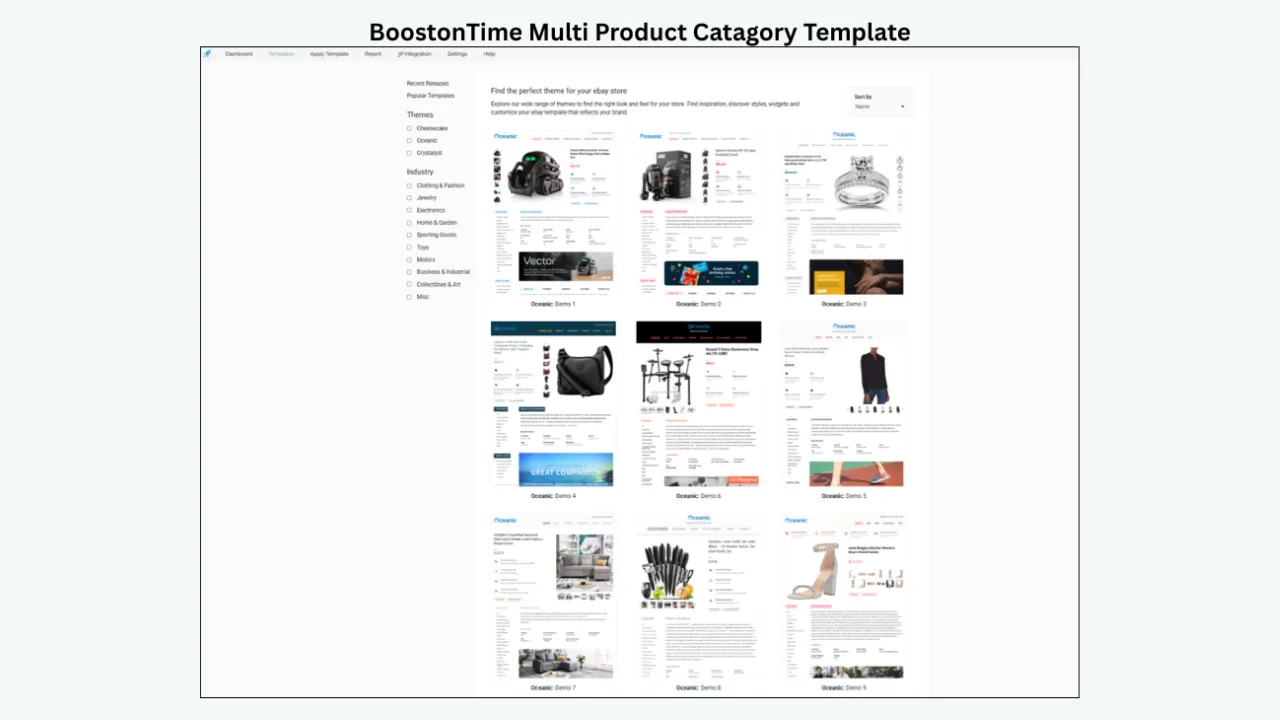
Static and dynamic information reduce repetitive work
Reusable modules can hold a logo, menu, banners, service explanation and store policies. Product-specific areas can populate supported data such as title, price, currency, images and related products when the template is applied or updated.
This separation matters at scale. It reduces the temptation to copy an old description and accidentally leave the wrong price, model or image reference in a new item. It also makes a brand update easier because the reusable layer is designed as a template component rather than manually recreated prose.
Always review the final listing. Supported dynamic content depends on the source information, and an attractive template cannot correct inaccurate item data.
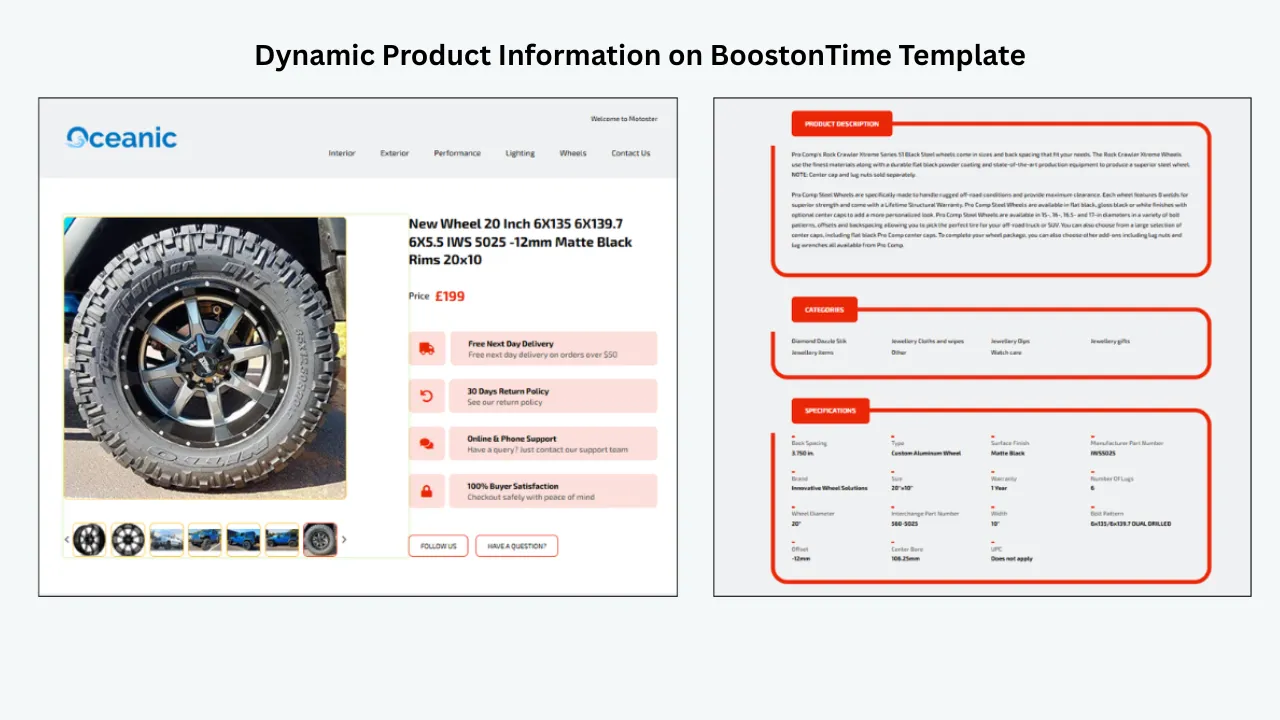
Batch Revision makes existing listings part of the plan
Many services look good during a new-listing demonstration but leave the seller wondering how to handle hundreds of live items. BoostOnTime Batch Revision can apply a template to one listing or a selected group. ETB cleans previous description HTML before inserting the fresh template content.
The safest rollout is staged. Apply the design to five or ten varied listings, inspect them on mobile and desktop, correct the template, then move to a larger group. Unlimited active-listing template updates support iteration without a separate update charge each time.
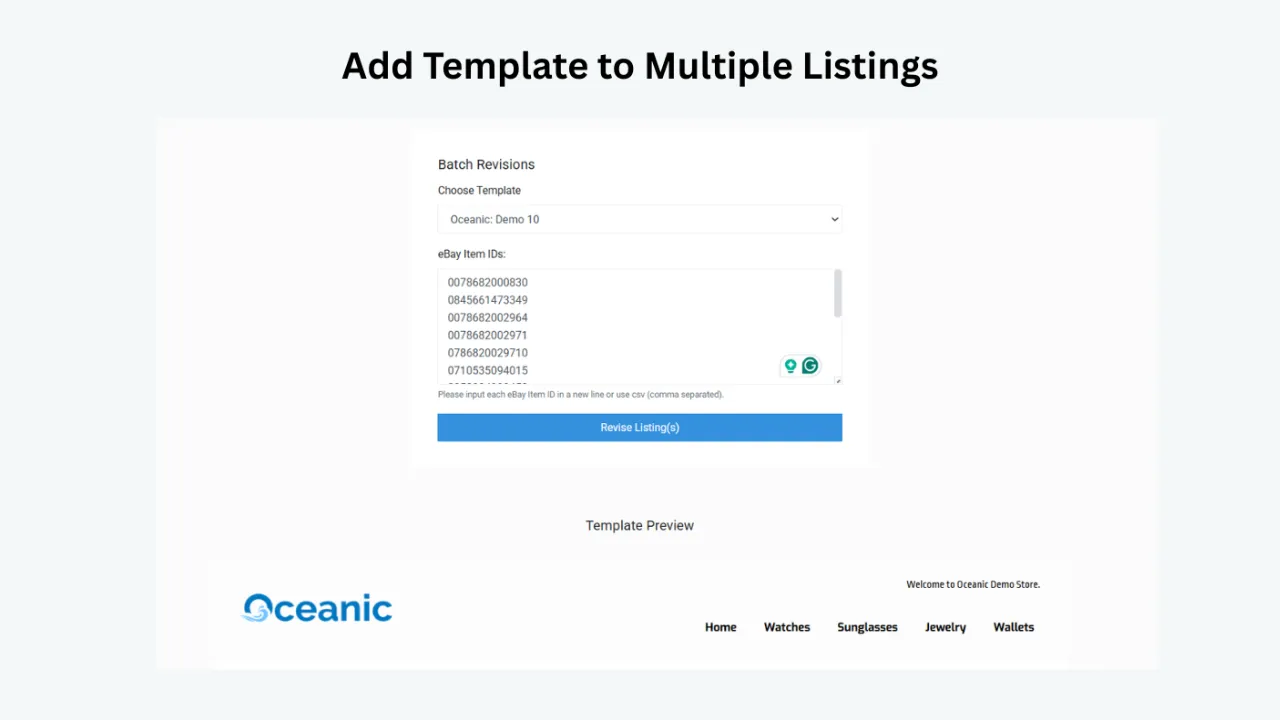
International and multichannel compatibility support growth
BoostOnTime supports 19 eBay sites and identifies compatibility with more than 10 multichannel systems. This does not remove the need to localize language, shipping, currency and legal information. It does mean sellers can assess ETB as part of a wider listing workflow rather than assuming it is limited to one domestic setup.
When comparing competitors, ask the same questions: which eBay sites are supported, whether each marketplace account changes the price, how a cross-listed product is counted and whether template content is appropriate for each locale.
A Practical Formula for the True Annual Cost
Use this formula before choosing any service:
The first five terms are usually visible in money. The final two require an honest operational estimate.
Suppose a platform costs $19 per month but requires an extra $20 helpdesk add-on and a higher plan when the catalogue exceeds 100 listings. The real annual cost is not $228. It is the price of the qualifying plan, the add-on and the time required to migrate and maintain the catalogue.
Now suppose BoostOnTime ETB costs $59.88 annually and covers the required template workflow. If the seller already has separate order and inventory tools, the lower focused cost is meaningful. If the seller needs those wider functions and would otherwise buy another system, a suite may produce better total value despite its higher sticker price.
Do not force an artificial return-on-investment claim. No provider can responsibly promise that a template will generate a fixed sales increase. Evaluate measurable operational results instead: time to build a template, number of manual edits, ability to update selected listings, mobile readability, error rate and consistency across categories.
Monthly or Annual: Which Billing Cycle Should You Choose?
Monthly billing is usually best during evaluation, seasonal use or uncertain catalogue changes. The higher rate buys flexibility. Annual billing is usually best after the workflow has been tested and the business expects stable use throughout the year.
For BoostOnTime, the break-even logic is simple. The annual plan costs $59.88. Nine months on the $6.99 monthly plan would cost $62.91, already more than the annual charge. If you expect to use ETB for nine months or longer and are comfortable with an annual commitment, the yearly option has the lower base cost.
Do not choose annual billing only because the discount looks attractive. Complete these checks first:
- Build a real template using the modules your category needs.
- Apply it to a small, varied sample of listings.
- Test desktop, tablet and mobile presentation.
- Confirm product title, price, currency, images, descriptions and specifications.
- Test Batch Revision on a controlled group.
- Confirm the workflow with any multichannel system you use.
- Read the current billing, renewal and cancellation terms.
Once those checks pass, annual billing converts a proven tool into a more economical long-term subscription.
How to Test BoostOnTime ETB During the Seven-Day Trial
Do not spend the trial browsing themes without building a production example. A structured test produces a much better decision.
Day 1: choose representative listings
Select five to ten items that reveal the real complexity of your catalogue. Include a short title, a long title, several image counts, different conditions, a product with many specifications and at least one listing from each important category.
Day 2: define the reusable brand layer
Add the logo, core colours, menu, concise Why Us content and accurate policies. Avoid large decorative banners until the essential product path works. A buyer should identify the seller without the brand layer overpowering the item.
Day 3: build the product-information order
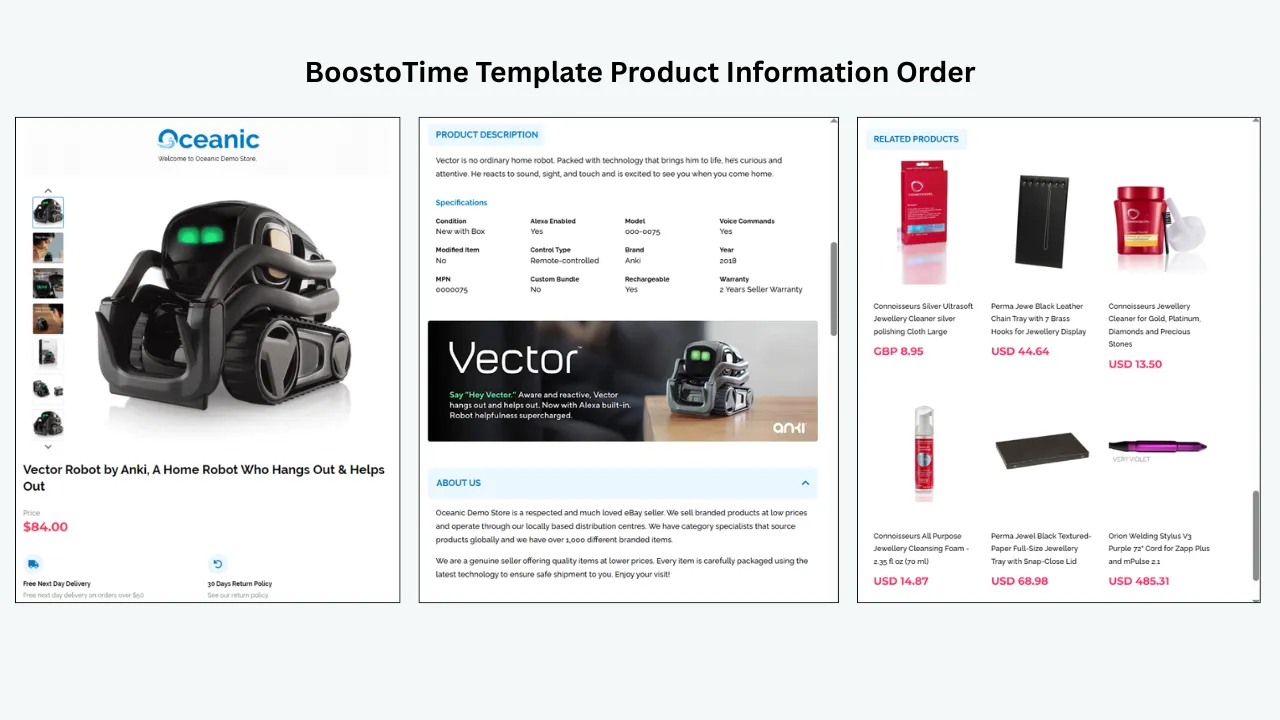
Choose the modules that answer buyer questions. Put title, price, images, description and specifications in a logical sequence. Add Related Products only when the suggestions are relevant. Save separate category templates if the information order genuinely differs.
Day 4: test responsive views
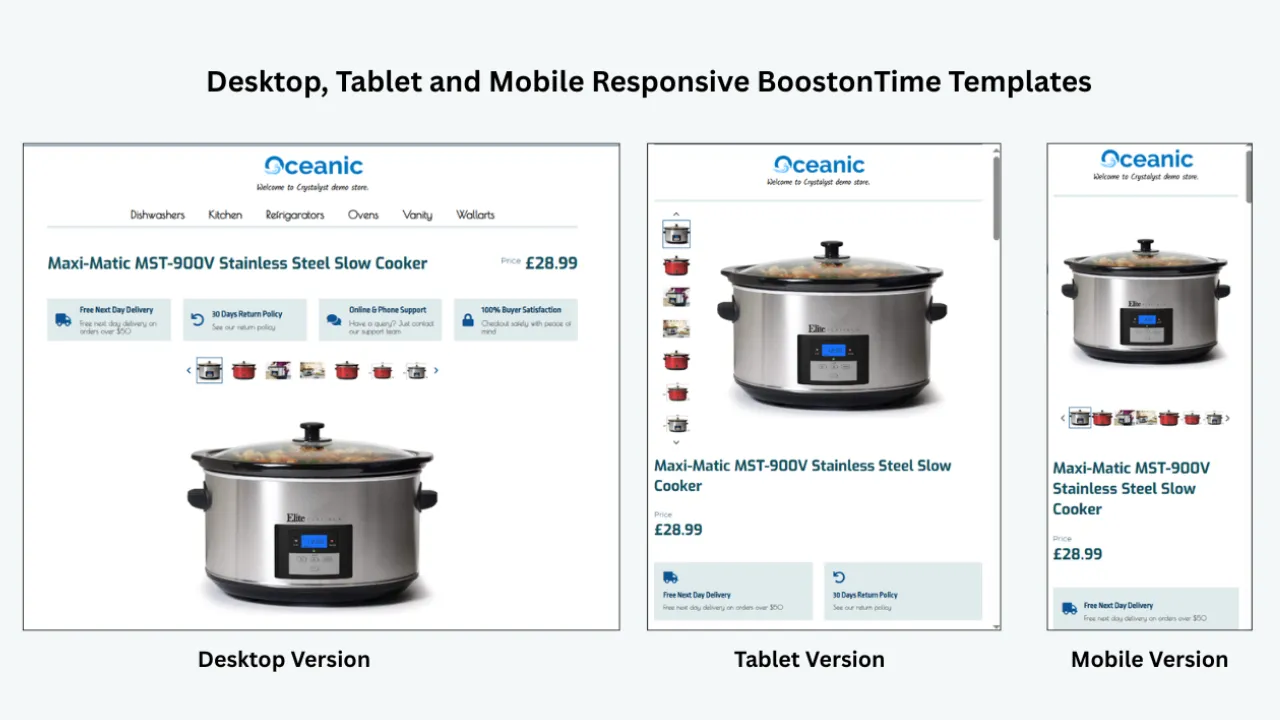
Use the available preview and inspect the live result on actual devices when possible. Check image behavior, text size, table width, policy tabs, menu links and the length of each section. Long specification values and unusual titles often expose layout problems that sample content hides.
Day 5: apply a controlled batch
Use Batch Revision on a small selected group. Confirm that old HTML is cleaned as expected and that every listing receives the correct template. Compare the source listing information with what buyers see.
Day 6: make one shared update
Change a reusable message or template element and run the appropriate update process. This tests the maintenance workflow—the part that will matter months after launch.
Day 7: score the result
Rate setup time, ease of use, mobile clarity, data accuracy, category flexibility and revision effort. Compare those results with the subscription cost. If ETB solves the template problem, choose monthly for flexibility or annual for the lower effective rate. If a required capability is missing, identify it precisely before considering a larger suite or custom service.
Hidden-Cost Checklist Before You Subscribe
Ask every provider these questions and keep the answers with your purchase decision:
- Is the advertised monthly figure billed monthly or prepaid annually?
- How many active, scheduled or monthly-created listings are included?
- Does the same product count again on each marketplace or channel?
- Are there GMV, transaction, processing or storage charges?
- How many eBay accounts, stores and team members are included?
- Is the template designer included in the entry tier?
- Are responsive designs, hosting and image storage included?
- Does a custom design require a separate setup fee and ongoing subscription?
- Can I create multiple templates for different categories?
- Can I apply changes to existing listings in selected groups?
- What happens to the listing design when the subscription ends?
- Are support, onboarding, migration or consultation separately billed?
- Does the provider add VAT, sales tax or another compulsory charge?
- Can I test the workflow with real listings before paying annually?
The checklist prevents two opposite mistakes: choosing a plan that becomes expensive at scale, or paying for a premium suite when a focused template builder would solve the actual problem.
Which Service Is Best for Each Type of Seller?
This table is a fit guide, not a universal ranking. BoostOnTime is our strongest recommendation for the template-focused use case because its price and features align directly with that job. A competitor may be the correct choice when the seller’s main need falls outside that scope.
Frequently Asked Questions
Current entry pricing ranges from no additional subscription for eBay Seller Hub’s native reusable templates to $6.99 monthly for BoostOnTime ETB, $12.95 for Auctiva Base+, $19 for 3Dsellers Essential and $25 plus a 5% processing fee for WonderLister Beginner. Managed custom-design subscriptions can begin higher and may require an initial design package. Compare annual cost, limits and add-ons rather than the headline alone.
BoostOnTime ETB has the lowest published paid entry price in this comparison at $6.99 month to month or $59.88 yearly, equivalent to $4.99 per month. eBay Seller Hub and some pre-designed libraries have free options, but they do not provide the same combination of responsive modular design, dynamic content and active-listing revision workflow.
Annual plans usually have a lower effective monthly rate, but they require a longer commitment and upfront payment. They are cheaper only when the service fits and will be used for enough of the year. Test first, then compare the annual total with expected monthly usage.
For BoostOnTime ETB, it means the subscription does not impose a separate charge for each template update applied to active listings. It does not mean every eBay selling service is unlimited. Marketplace rules, account limits and external systems still apply.
No. A provider should not guarantee search ranking, traffic or conversion from a template alone. A professional responsive layout can make product facts, images, policies and brand information easier to use, while a consistent workflow can reduce maintenance errors. Sales still depend on demand, price, offer quality, photographs, item specifics, service and competition.
It can be. Sellers with a small catalogue and simple branding may be well served by eBay Seller Hub or a free pre-designed library. Move to a paid service when responsive modular design, multiple category templates, dynamic product displays or efficient active-listing updates create clear operational value.
Compare total service scope. A custom package may include creative discovery, unique design, implementation and support. A self-service builder gives you tools and reusable structures. Include the initial design quote, ongoing subscription, revision fees, ownership, hosting and internal time. They are different purchasing decisions.
Not automatically. Template price is not a ranking signal. Strong eBay listings depend on accurate titles, relevant item specifics, competitive offers, clear images, complete product information and good service. A well-structured template supports buyer clarity but cannot replace those fundamentals.
Prioritize predictable pricing, multiple-template support, responsive presentation, a safe method for revising existing listings and compatibility with your current workflow. Also check how listings are counted across accounts and channels. BoostOnTime ETB is particularly strong when the growing need is template consistency rather than a replacement for every operations tool.
Final Verdict:
Choose the Smallest Service That Fully Solves the Job
Subscription pricing becomes clear when sellers stop treating every platform as the same product. Native reusable forms, free design libraries, focused template builders, all-in-one seller suites and managed custom services belong to different categories. The cheapest plan can be inadequate, while the most expensive can include tools the business never uses.
For sellers who primarily need professional eBay listing templates, BoostOnTime ETB offers the best balance of price, flexibility and maintainability in this comparison. The monthly plan is $6.99, and the $59.88 annual plan brings the effective rate to $4.99 per month. The subscription includes responsive themes, more than 20 customizable modules, multiple templates, supported dynamic product information, Batch Revision and unlimited template updates for active listings.
That combination helps a small seller begin professionally and gives a growing catalogue a practical update path. Electronics, fashion, auto parts, collectibles and general merchandise can use different module structures while retaining one recognizable brand. Existing listings can be handled in controlled groups instead of being abandoned to an outdated design.
The responsible next step is not to buy on a promise of instant sales. Start the seven-day BoostOnTime ETB trial today and test five to ten real listings. Check mobile presentation, product-data accuracy, category flexibility and the Batch Revision workflow. If ETB solves the template problem, use monthly billing for flexibility or choose the annual plan for the strongest long-term value.
🚀 Start Your Seven-Day BoostOnTime ETB Trial
boostontime.com/ebay-template-builder